

Our clients have different financial needs and goals, and therefore, they may invest for different reasons. One major reason is to grow their wealth—for example, in preparation for retirement.
Whatever their reason for accumulating money, there’s another concern that creates the need to invest – your money today will likely buy less tomorrow.
Inflation refers to the rise in the level of prices of consumer goods and services over a specific period of time. People need to spend money on goods and services to survive (i.e., food, shelter, medical care), hence inflation impacts every human on the planet.
A consumer can experience significant erosion in their lifestyle, even at lower long-term inflation rates. For example, at 2.7% average annual inflation, which is the rate observed in Australia from 1995 to 2024, investors would have lost approximately 50% of their purchasing power over the past three decades if they had not invested their money.
Dealing with inflation encompasses one of two goals: hedging or outpacing it.
Hedging Inflation
Investors may want to maintain their purchasing power and eliminate the risk of unexpected inflation. For example, people nearing retirement or those with short-term spending needs may be sensitive to changes in inflation. At Alman Partners, we have found that some investors incorrectly assume that assets which aim to provide a stable return above the RBA cash rate (for example, term deposits) will help provide this hedge. History has shown this is not the case.
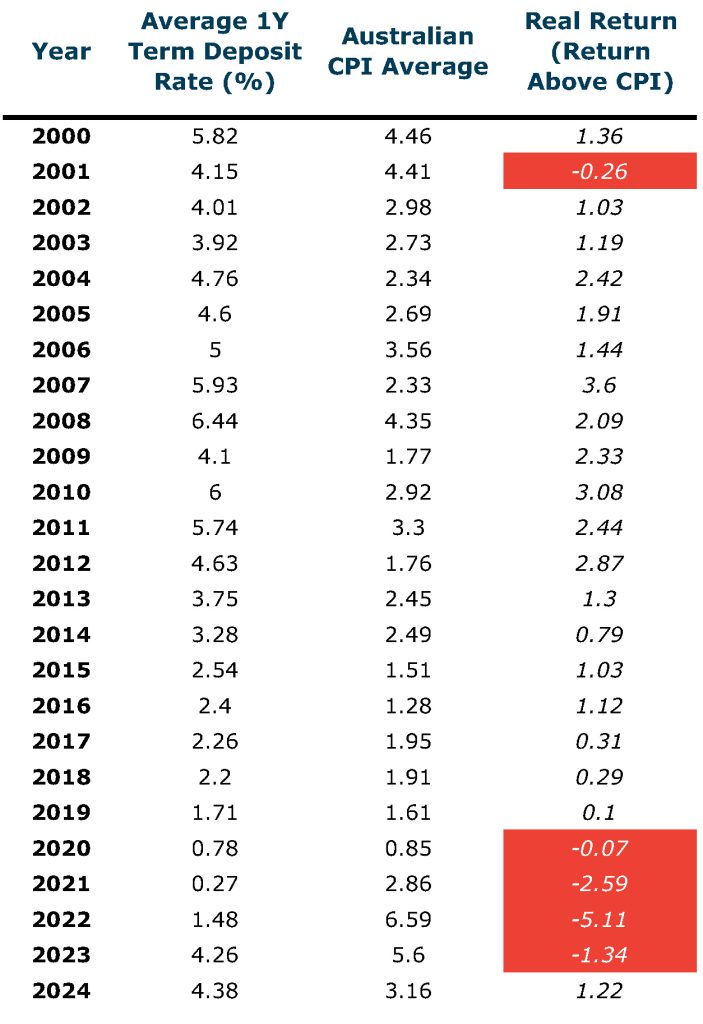
Term Deposits www.rba.gov.au; Retail deposit and investment rates; Banks’ term deposits 1 Year ($10,000) are averages of the five largest banks’ rates. We take the rate at the start of the year as the actual return 1 year later. Consumer price index www.abs.gov.au; All groups; Original; Quarterly change (in per cent). Interpolated quarterly data into monthly data.
Outpacing Inflation
Growing wealth beyond maintaining purchasing power is the long-term objective for many investors. They can allocate a portion of their portfolio to assets that have historically outpaced inflation over time. Market history shows that many major asset classes—including stocks and longer-term bonds—have done this. On average, this is true in periods of both lower and higher inflation.
When you consider the long-term threat of inflation, not investing means taking risks, too. If you don’t grow your money, you may not be able to afford things in the future. You should view inflation as both a consumer and investor—and have a plan to manage its potential impact on spending and wealth. Choose the right set of tools for your objective and consider getting qualified financial advice.
James Alexander (CFP® Professional, GradDipFP, MFinP, BBus [Fin, Mgt]) is an Authorised Representative of Alman Partners Pty Ltd, Australian Financial Services Licence No: 222107.
Performance data shown represents past performance or simulated performance. Past performance is no guarantee of future results and current performance may be higher or lower than the performance shown. The investment return and principal value of an investment will fluctuate so that an investor’s shares, when redeemed, may be worth more or less than their original cost.
Any information provided to you was purely factual in nature. It has not been taken into account your personal objectives, situation or needs. The information is objectively ascertainable and is not intended to imply any recommendation or opinion about a financial product. This does not constitute financial product advice under the Corporations Act 2001 (Cth). It is recommended that you obtain financial product advice before making any decision on a financial product such as a decision to purchase or invest in a financial product. Please contact us if you would like to obtain financial product advice.