

What if the plan was not simply to earn more, work longer and hope retirement eventually catches up?
Graeme Hart, Rupert Murdoch and Andrew “Twiggy” Forrest built very different businesses, but borrowing helped each of them expand. Hart financed acquisitions, Murdoch funded media expansion, and Fortescue borrowed billions to help build mines and infrastructure.
Debt helped bring forward opportunities that existing capital alone could not fund. That is the attraction of leverage: putting more money to work today in pursuit of greater wealth tomorrow. On a scale that suits your finances and appetite for risk, the same principle can help build a life less dependent on your next pay packet. So why do we teach young Australians to fear debt before we teach them how to use it?
To be clear, a 20% credit card balance is not a wealth strategy. It is an expensive subscription to last month’s spending. But borrowing to acquire a worthwhile asset is a different conversation, one young Australians deserve to understand early.
The people with the most time to benefit from leverage often have the least access to it.
What leverage actually does
Imagine you have $100,000. Without borrowing, you can buy $100,000 of assets.
Add a $400,000 loan and you can buy a $500,000 asset. You now receive the gains and wear the losses on something five times the size of your starting equity.
If that asset rises 5%, its value increases by $25,000. Before costs, that is a 25% gain on your original $100,000. If it falls 5%, you lose the same $25,000: a 25% hit to your equity. A 20% fall would wipe out that initial equity before selling costs, while the debt remains.
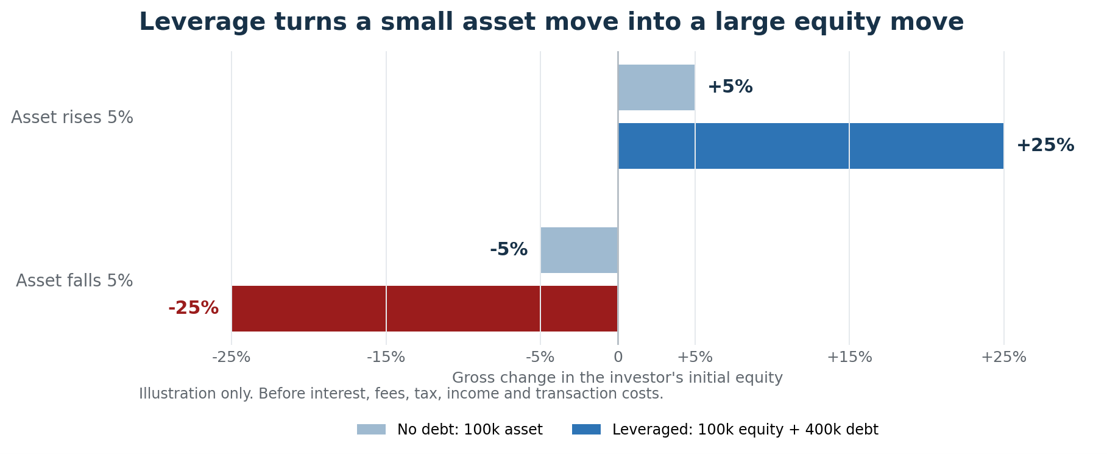
Same $100,000 starting equity. Debt stays at $400,000 in the leveraged example. These illustrate price changes, not total returns or forecasts.
Interest, fees, tax and running costs affect the final result. The investment needs a credible prospect of earning more, after tax, than the full cost of the investment and loan, with enough upside to justify the extra risk. Cheap debt still needs a worthwhile asset. That is the attraction: you can start owning an asset and participating in its income and potential growth before you have saved its entire purchase price.
Used well, leverage buys you more time as an owner.
Your biggest asset might not be in your bank account
Young Australians are often told to be careful with money. Fair enough. But being careful should not mean ignoring the biggest advantage they have.
Time.
Thirty or forty years gives you time to build earning power, recover from setbacks and invest through multiple market cycles. The answer is not a bigger punt, but a deliberate plan: diversified investments, regular contributions and borrowing you can service through a downturn. Leverage can put more money to work earlier, giving those assets more time to participate in the market.
Time can help you carry investment risk. Cash flow helps you carry debt.
The bank cannot lend against your potential
Unfortunately, “Yeah mate, I should be earning heaps in ten years” does not get you very far on a loan application. The bank needs numbers it can check today: income, expenses, existing commitments and what you can contribute.
Put simply, you need money to get in and income to keep going. That is the kicker: debt can help you build wealth, but accessing it often requires a financial head start.
So how do you build that starting position sooner?
The road to debt starts before the loan
Before borrowed money can work for you, your own money needs a job description.
Some of it funds life today. Some of it needs to build the position that funds life later. That means developing your earning power, saving a deposit or investment contribution, dealing with expensive debt and keeping enough cash aside to stay on course when life gets inconvenient.
A pay rise is particularly useful here. It can increase your ability to invest, your ability to borrow, or the specification of your next car. Worth deciding which before the money volunteers itself.
You don’t need a house to start
Home ownership is one way to build wealth, but it is not the only starting point. You can also begin by investing regularly, or in some cases, use an investment loan to help build a diversified portfolio before owning property. Some lenders offer options designed for people who are still working towards a future home deposit.
If you are using debt to invest, the key is making sure the repayments are manageable and that you could still cope if markets fell, interest rates increased or your income changed. The main point is that you do not necessarily need to wait until you own a home before you start building assets.
The home can open the door to cheaper debt. For many young Australians, a home is their first major use of leverage. You already need somewhere to live, and lenders are generally willing to offer cheaper debt when a loan is secured against residential property.
There can also be some help getting through the front door. Eligible first home buyers may have access to the First Home Super Saver Scheme, low-deposit home guarantee programs, state grants or stamp duty concessions. The rules vary, but a bit of homework before buying can make a meaningful difference.
Then the home can start doing more than giving you somewhere to sleep.
As you repay the mortgage, the debt falls. If the property also increases in value, the gap between what it is worth and what you owe grows. That gap is your equity.
Subject to your income, borrowing capacity and lender approval, some of that equity may later be used to support a separate investment loan. That borrowed money could then be invested outside the home across diversified shares, managed funds or other productive assets. In other words, the home does not have to remain your entire investment strategy. It can become the first asset that helps you build the next ones.
If the borrowing is used to acquire income-producing investments, the interest may also be tax deductible. The tax treatment generally follows what the borrowed money is used for, not simply the property sitting behind the loan, so keeping the structure clean matters. The deduction helps, but it does not remove the risk. The investment still needs to earn its keep, and the repayments still need to work if markets fall, rates rise or life does what life tends to do.
Where debt recycling fits
Borrowing against increased equity usually means adding to your total debt. Debt recycling is a related but different strategy: using available cash to reduce non-deductible home debt, then reborrowing that amount in a separate investment loan to buy income-producing assets.
That can keep total borrowing broadly unchanged at the point of recycling, while replacing part of the private home debt with debt used for investment.
Your home builds the equity. The equity opens the door. The investment loan broadens what you own.
One property, two addresses
Owning a home does not mean you have to live in it forever. Once any first home scheme and lending conditions allow, you may decide to rent the property out and rent somewhere else yourself. That is commonly known as rentvesting.
Earlier in life, that can make a lot of sense. You may care more about flexibility, being close to work or living somewhere that suits your lifestyle than having three spare bedrooms and a lawn that apparently needs your attention every second weekend. If the property can be rented for more than it costs you to rent somewhere suitable, the difference can help meet the mortgage and other ownership costs. The property starts producing income while you keep more control over where and how you live.
The numbers still need to include interest, rates, insurance, maintenance, vacancy and tax, not just the two rental figures. But when they stack up, rentvesting can separate your investment decision from your lifestyle decision. You can own where the investment makes sense and live where your life makes sense.
The home is the beginning, not the entire strategy
These two pathways can eventually work together. The property may produce rent, its equity may support investment borrowing, and your regular income may continue building assets outside the home. That could mean shares, managed funds, another carefully selected property or a genuine business opportunity. The important shift is that your wealth becomes less dependent on one property, one location or one pay packet.
For younger Australians, the opportunity is to build the income and savings that open the door to useful debt, then put that borrowing to work while time is still on your side. The destination is not an impressive collection of mortgages. It is a collection of productive assets that eventually gives you more control over how much you work, where you live and what comes next.
Debt is the tool. More freedom is the point.
Joshua White (MFin, BCom, BEcon) is an Employee of Alman Partners Pty Ltd, Australian Financial Services Licence No: 222107.
Performance data shown represents past performance or simulated performance. Past performance is no guarantee of future results and current performance may be higher or lower than the performance shown. The investment return and principal value of an investment will fluctuate so that an investor’s shares, when redeemed, may be worth more or less than their original cost.
Note: This material is provided for GENERAL INFORMATION ONLY. It has not been taken into account your personal objectives, situation or needs. The information is objectively ascertainable and is not intended to imply any recommendation or opinion about a financial product. This does not constitute financial product advice under the Corporations Act 2001 (Cth). It is recommended that you obtain financial product advice before making any decision on a financial product such as a decision to purchase or invest in a financial product. Please contact us if you would like to obtain financial product advice.